
 By Mobi Roller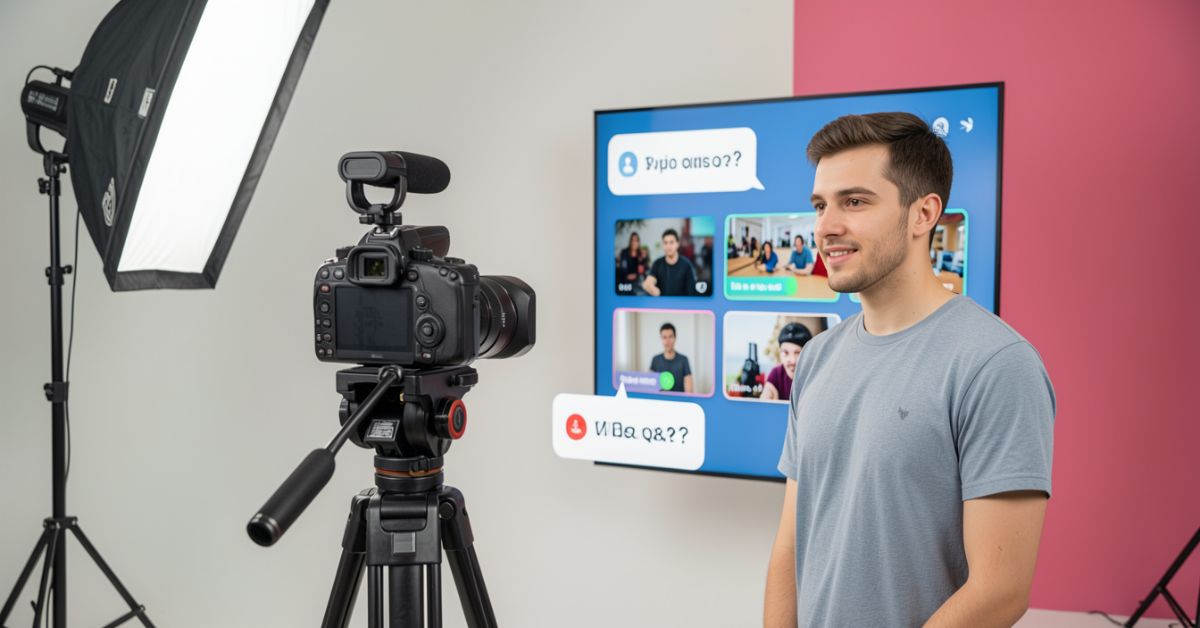
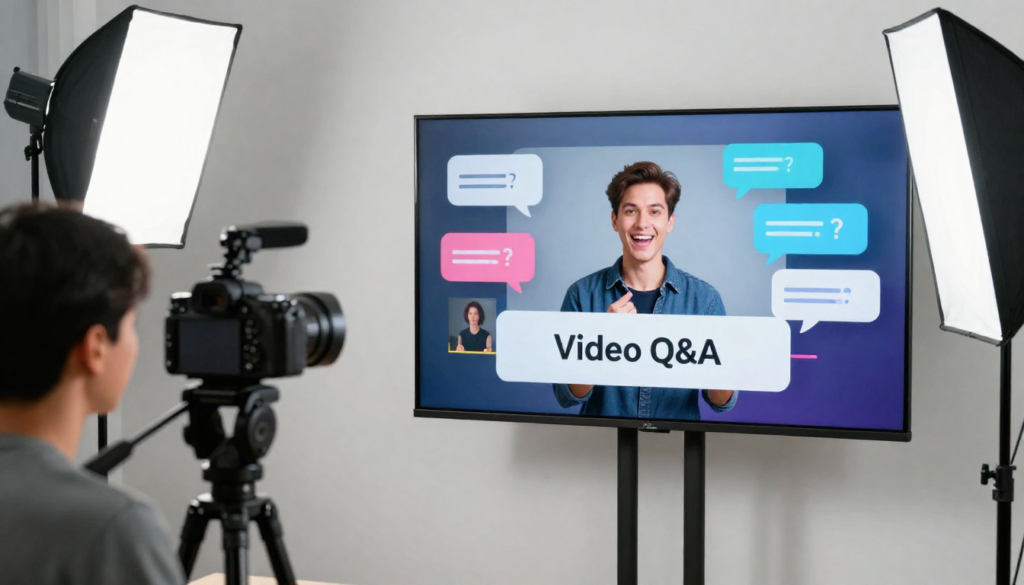
Video&a describes any video experience where the viewer is an active participant rather than a passive observer. Traditional video is a monologue. Video&a is a dialogue.
Thank you for reading this post, don't forget to subscribe!“Video&a transforms the screen from a window you look through into a door you can walk through.”
Where a standard YouTube video plays from start to finish with no input from you, a video&a experience might pause to ask your opinion, let you choose what happens next, quiz you on what you just learned, or respond to your live comment in real time.
The Three Core Components of Video&a
Every video&a experience is built on three interconnected elements:
- Video Content: The core media filmed footage, animated explainers, AI-generated clips, or live streams.
- Connection (The Technology): The layer that links the viewer to the content interactive overlays, poll stickers, live chat APIs, clickable hotspots, or branching logic.
- Action (Viewer Response): The moment the audience participates answering a question, clicking a choice, voting, or reacting. This is what transforms passive viewing into a genuine video&a experience.
Video&a as an AI Tool Ecosystem
The second dimension of video&a is the rapidly growing world of AI-powered video tools. Platforms like Synthesia, Descript, and RunwayML are redefining what it means to create video, making professional production accessible to anyone with a laptop and an idea.
These tools enable creators to generate realistic AI presenters, automatically transcribe interviews, remove backgrounds without a green screen, and repurpose a single recording into dozens of social media clips all at a fraction of traditional production cost and time.
How Video&a Differs from Traditional Video
One-Way vs Two-Way Communication
The most fundamental difference between traditional video and video&a is the direction of communication. Traditional video broadcasts a message from creator to viewer with no return channel. Video&a opens a feedback loop that makes the experience personal, responsive, and engaging.
| Traditional Video | Video&a (Interactive) |
| One-way broadcast (monologue) | Two-way dialogue with viewers |
| Passive observation | Active participation & interaction |
| Fixed, linear storyline | Choose-your-own-path narrative |
| No feedback loop | Real-time polls, Q&A, voting |
| Static viewer count metric | Engagement rate & interaction data |
| Creator-controlled experience | Audience co-creates the outcome |
Interaction vs Observation: What This Looks Like in Practice
The shift from observation to interaction is powered by specific features and technologies. These include:
- Poll stickers and Q&A stickers (Instagram, YouTube, TikTok)
- Live chat integration and real-time Q&A during streams
- Clickable hotspots embedded inside video players
- Branching narratives where viewers choose the story path
- In-video quizzes used for assessment in e-learning platforms
- Choose-your-own-adventure style content on platforms like Netflix and YouTube
Top Use Cases: Where Video&a is Changing the Game
Business & Marketing
Businesses are discovering that interactive and AI-powered video dramatically outperforms traditional content in engagement and conversion rates. Key applications include:
- Product demos with clickable feature callouts that answer buyer questions in real time.
- Customer onboarding videos that branch based on user role or experience level.
- AI-generated training materials using tools like Synthesia to create avatar-led tutorials without filming a single minute of real footage.
- Marketing campaigns where viewers vote, choose a product, or influence the ad storyline.
- Customer service video bots that guide users through troubleshooting steps interactively.
Education & E-Learning
Education is arguably the sector most transformed by video&a. Research consistently shows that active learning dramatically improves knowledge retention compared to passive video lectures.
- Interactive quizzes embedded mid-lesson to test comprehension before continuing.
- Branching scenario simulations for medical, legal, or management training.
- AI avatars that deliver consistent, multilingual lessons at scale using tools like Elai.io.
- Automated transcription (via Descript or HappyScribe) to create searchable, accessible lecture content.
- Student assessment through built-in polling and response collection.
Content Creators & Live Streaming
For independent creators and streamers, video&a is the key to building loyal, engaged communities rather than passive subscriber counts.
- Instagram Live and Facebook Live with real-time Q&A, poll stickers, and emoji reactions.
- YouTube Live Super Chats and member-only interactive segments.
- Podcast repurposing: using tools like Riverside and Vizard.ai to turn a single interview into clips, reels, and highlight videos automatically.
- Interactive music videos where fans choose the narrative outcome.
- Restream for broadcasting simultaneously to multiple platforms with unified live chat.
The Best AI Tools for Video&a Creation (2026 Update)
The AI video landscape has exploded with powerful tools. Here is a curated breakdown of the most important platforms, organized by category.
AI Video Generators (Text-to-Video)
These tools let you create professional video content from a text script no camera, studio, or on-screen presenter required.
- Synthesia: The industry leader for AI avatar videos. Type a script, choose an avatar, and generate a polished presenter-led video in minutes. Ideal for corporate training, onboarding, and HR communications.
- Elai.io: A strong Synthesia alternative with exceptional multilingual support (75+ languages) and the ability to clone your own likeness as an AI avatar.
- RunwayML (Runway Gen-3): Best for creative and cinematic AI-generated footage. Offers motion tracking, inpainting, and video generation from text prompts or reference images.
AI Video Editors & Transcribers (Video-to-Text)
These tools are built for efficiency turning raw footage into polished, repurposed content fast.
- Descript: Edit video like a document. Delete words from the transcript and the video clip removes automatically. Features Overdub for AI voice cloning and Green Screen removal.
- Riverside.fm: Studio-quality remote recording for podcasts and interviews, with automatic transcription and one-click clip generation.
- VEED.io: Browser-based editor with auto-subtitles, translations, and social media formatting in one intuitive workflow.
- HappyScribe: Best-in-class transcription accuracy (99%+) for interviews, lectures, and webinars. Supports 60+ languages.
- Vizard.ai: Automatically identifies the best moments in long-form video and generates short clips optimized for TikTok, Instagram Reels, and YouTube Shorts.
Tool Comparison Matrix
Use this quick-reference table to identify the right tool for your specific video&a goal:
| Tool | Best Feature | Best For | Free Tier? | Category |
| Synthesia | Realistic AI avatars | Training & HR videos | Yes (limited) | Text-to-Video |
| RunwayML | Gen-3 motion tracking | Creative & cinematic | Yes (trial) | Generative AI |
| Elai.io | Multilingual support | Global e-learning | Yes (1 video) | Text-to-Video |
| Descript | Overdub voice cloning | Podcast repurposing | Yes (watermark) | Video-to-Text |
| VEED.io | Auto subtitle generator | Social media clips | Yes (watermark) | Video Editor |
| HappyScribe | 99%+ transcription accuracy | Interviews & webinars | No (trial only) | Transcription |
How to Create Your First Video&a: A Step-by-Step Guide
Ready to create your first interactive or AI-powered video experience? Follow these four steps to go from idea to published video&a content.
Define Your Goal
Before choosing any tool or platform, clarify what you want your audience to do. Choose from one of these three goal categories:
- Education: You want viewers to learn and retain information. Focus on quizzes, branching scenarios, and AI avatar-led lessons.
- Marketing: You want viewers to engage, choose, and convert. Focus on interactive product demos, polls, and personalized video funnels.
- Community & Entertainment: You want viewers to participate and share. Focus on live stream interaction, choose-your-own-path content, and social media polls.
Choose Your Platform or Tool
Match your goal to the right platform based on audience size, budget, and technical comfort:
- Beginners: Start with Instagram Reels, YouTube Shorts, or TikTok. These platforms have built-in interactive features (polls, Q&A) that require zero technical setup.
- Intermediate: Use Descript or VEED.io for editing and subtitle generation. Use Riverside for clean interview recordings.
- Advanced: Use Synthesia for AI avatar videos or RunwayML for generative creative content.
Map Out the Interaction
Decide where the action moment happens in your video. Common interaction structures include:
- Quiz-at-the-End: Deliver information, then test comprehension with a built-in question. Best for education.
- Mid-Video Poll: Pause the content mid-way to ask viewers for their opinion or preference. Best for marketing.
- Branching Decision Tree: Offer viewers two or more paths at a key moment. Best for entertainment and scenario training.
- Live Q&A Layer: Keep a permanent Q&A or chat feature active throughout. Best for live streaming.
Create, Test, and Publish
Use your chosen tool to produce the content, then test the interactive elements on multiple devices before publishing. Key checklist items:
- Verify all branching paths or interactive elements function correctly on both mobile and desktop.
- Add subtitles or captions to maximize accessibility and watch time.
- Test load time heavy interactive videos may require a CDN or hosting optimization.
- Review analytics after launch: monitor click-through rates on interactive elements, poll responses, and average watch time to refine future videos.
Why Video&a is Important for Everyone
Benefits for Viewers
The switch from passive to active video engagement produces measurable improvements in the viewer experience:
- Higher Retention: Active participation keeps attention focused. Studies show interactive e-learning can increase knowledge retention by up to 25-60% compared to passive video lectures.
- Sense of Agency: When viewers can influence a story or choose their learning path, they feel invested in the outcome.
- Personalized Experience: Video&a adapts to individual choices, making the same base content feel uniquely tailored to each viewer.
- Real-Time Feedback: Live interaction features create a sense of community and immediacy that traditional recorded video cannot replicate.
Benefits for Creators & Businesses
- Deep Audience Insights: Interactive polls and Q&A features provide direct, unfiltered data about what your audience thinks, wants, and struggles with.
- Longer Engagement: Interactive content consistently outperforms passive video on average watch time and completion rate metrics.
- Global Reach: AI tools with multilingual support (like Elai.io and HappyScribe) let creators localize content for international audiences without traditional translation overhead.
- Cost Efficiency: AI-generated videos eliminate the need for expensive studios, cameras, and on-screen talent for standard explainer and training content.
- Scalable Personalization: A single branching video can serve hundreds of audience segments without creating hundreds of separate videos.
The Future of Video: What is Next for Video&a?
We are at the beginning of a fundamental transformation in how humans communicate through video. The convergence of AI generation, interactive design, and real-time personalization points toward a future where every video experience is unique to the individual watching it.
Emerging trends already shaping the next generation of video&a include:
- Shoppable Video: Viewers click on clothing, furniture, or products directly within a video to purchase instantly already gaining traction on TikTok Shop and Instagram.
- Personalized News Experiences: Interactive news videos where viewers select the stories and depth of coverage they want, eliminating passive scrolling.
- AI-Driven Real-Time Personalization: Videos that adapt their script, visuals, and pacing in real time based on viewer behavior and preferences.
- Choose-Your-Ending Entertainment: Viewer-directed storytelling expanding from Netflix experiments into mainstream streaming.
- Immersive Video&a in AR/VR: Interactive video experiences embedded within spatial computing environments, blurring the line between video, game, and reality.
The creators and businesses who invest in video&a today both the interactive experience layer and the AI creation tools will be best positioned to lead in this emerging landscape.
Frequently Asked Questions (FAQs)
Is video&a the same as live streaming?
Not exactly. Live streaming is one context where video&a features appear particularly through live chat, Q&A, and polls. However, video&a is a broader concept that includes pre-recorded interactive videos, AI-generated content, and any format where viewers actively participate. Live streaming is a subset of video&a, not the whole picture.
What equipment do I need to get started?
The barrier to entry is remarkably low. A modern smartphone is sufficient to create and publish basic video&a content on Instagram or YouTube. For higher-quality output, a USB microphone and ring light dramatically improve perceived professionalism. For AI-generated video, you only need a laptop and an account with a tool like Synthesia no camera required at all.
Can video&a be used for business training?
Absolutely and it is one of the most effective applications. Branching scenario simulations, AI avatar-led onboarding modules, and interactive knowledge checks have been shown to significantly outperform traditional slide-based corporate training on both engagement and knowledge retention metrics.
Is there a free AI video generator I can try?
Yes. Synthesia offers a free demo with limited video creation. Elai.io provides one free video on signup. RunwayML has a free trial tier. VEED.io and Descript both offer free plans with watermarks. These are excellent starting points to explore AI-powered video creation before committing to a paid subscription.
What is the difference between Synthesia and RunwayML?
They serve fundamentally different creative purposes. Synthesia is a presenter-focused tool you provide a script and it generates a realistic AI avatar delivering that script on screen. It is best for structured, information-delivery content like training videos and product demos. RunwayML is a generative creative tool it generates or transforms video footage using AI models like Gen-3, making it ideal for artistic, cinematic, and experimental projects.
Can I convert existing YouTube videos into interactive content?
Yes, with the right tools. Vizard.ai and Descript can help repurpose existing YouTube videos into shorter, shareable clips. For adding interactivity to existing video, platforms like Wirewax or HapYak allow you to overlay clickable elements, quizzes, and branching choices on top of already-published video content.
Conclusion
Video&a is not a single product or a niche trend. It is the direction that all video communication is heading toward more engagement, more participation, more personalization, and more intelligent creation.
The two pillars explored in this guide are deeply connected: interactive video experiences give audiences agency and voice, while AI-powered creation tools give any creator regardless of budget or technical skill the ability to produce professional, scalable video content.
The best place to start is wherever you already are. If you post on Instagram, experiment with the Q&A sticker on your next Story. If you train employees, replace one slide deck this month with a Synthesia-generated interactive video. If you run a podcast, use Riverside or Vizard.ai to repurpose one episode into five short clips.
CLICK HERE FOR MORE BLOG POSTS