
 By Mobi Roller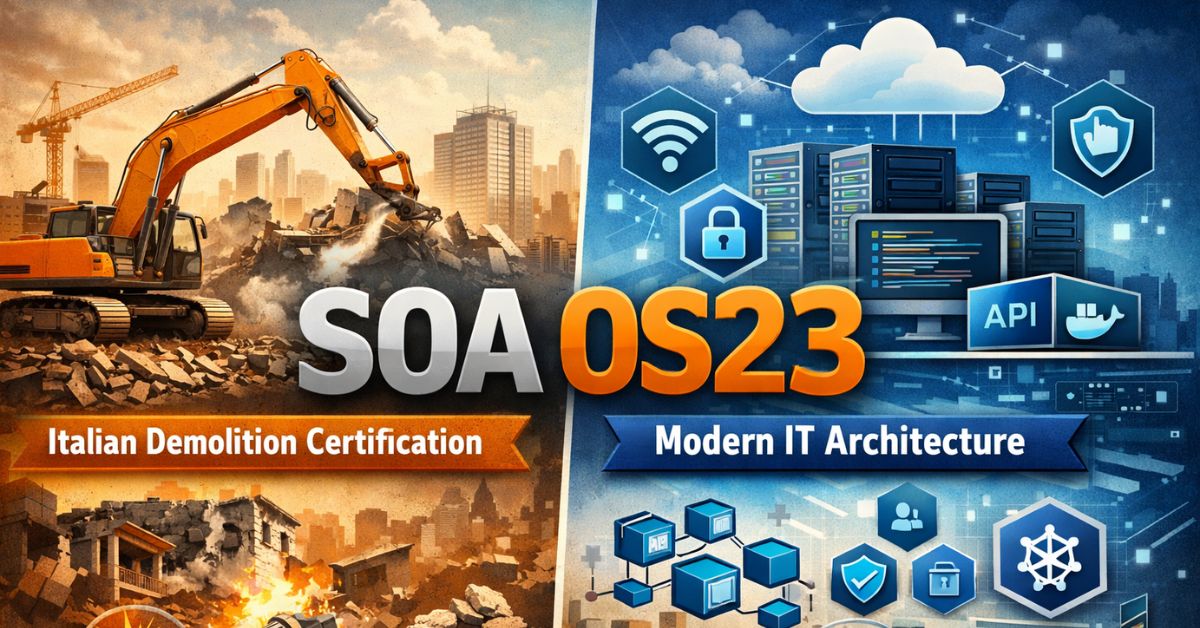
The term “SOA OS23” carries two distinct and important meanings across different professional domains. This comprehensive guide addresses both contexts to ensure clarity and provide valuable information regardless of your search intent.
Thank you for reading this post, don't forget to subscribe!In the Italian construction industry, SOA OS23 refers to a specialized certification category for demolition works (“demolizione di opere”) under the Italian public procurement system. This attestazione SOA is essential for companies seeking to participate in public tenders for complex demolition projects.
In the information technology sector, SOA OS23 represents a modern evolution of Service-Oriented Architecture, incorporating cloud-native capabilities, API-first design, and containerization technologies that have emerged as industry standards in 2023 and beyond.
This guide systematically explores both meanings, providing detailed information on regulatory frameworks, technical specifications, certification processes, and real-world applications.
What is SOA OS23 in Italian Public Works? (The Construction Context)
For construction professionals, contractors, and companies operating in Italy, SOA OS23 represents a critical certification that opens doors to specialized public sector contracts.
Definition and Regulatory Framework (DPR 207/2010)
SOA OS23 is a specialized category (categoria specializzata) within the Italian SOA certification system, specifically designed for companies performing demolition works. The certification is governed by the Decreto del Presidente della Repubblica 207/2010 (DPR 207/2010), with detailed specifications outlined in Allegato A (Annex A).
The SOA system (Sistema di Qualificazione) is Italy’s mandatory qualification framework for companies seeking to bid on public works contracts (appalti pubblici). OS23 falls within the “OS” category group, which encompasses specialized technical works requiring specific expertise and equipment.
The legal foundation was further refined by Decreto Ministeriale 154/2017, which updated certain administrative requirements and introduced digital certification processes. Companies must obtain their attestazione SOA from an officially recognized organismo di attestazione (certification body) authorized by the Italian Authority for Public Contracts (ANAC).
What Work Does OS23 Cover? (Scope & Techniques)
The OS23 certification specifically authorizes companies to undertake the following types of demolition projects:
- Complete building demolition (demolizione completa di edifici) – Full structural dismantling of residential, commercial, and industrial buildings
- Dismantling of industrial plants (smontaggio impianti industriali) – Decommissioning and removal of manufacturing facilities, power plants, and industrial infrastructure
- Controlled demolition using explosives (uso di esplosivi) – Precision blasting operations requiring specialized safety protocols and certifications
- Cutting of reinforced concrete structures (taglio di strutture in cemento armato) – Advanced cutting techniques for concrete and steel framework
- Collection, separation, and recycling of demolition materials (raccolta materiali di risulta, separazione, riciclaggio) – Sustainable waste management and circular economy practices
Modern OS23-certified companies employ various advanced demolition techniques:
- Controlled demolition techniques (tecniche di demolizione controllata) – Systematic dismantling that preserves adjacent structures and minimizes environmental impact
- Hydro-demolition (idrodemolizione) – High-pressure water jetting for precise concrete removal without damaging reinforcement bars
- Thermal lance cutting (taglio con lancia termica) – Ultra-high temperature cutting for heavy steel and concrete
- Diamond sawing and abrasive cutting (taglio per abrasione) – Precision cutting with diamond-tipped blades for minimal vibration and dust
These techniques require not only specialized equipment but also highly trained personnel with expertise in structural engineering (statica), safety protocols (sicurezza sul lavoro), and environmental regulations.
Is OS23 Certification Mandatory?
The mandatory nature of SOA OS23 certification depends on the specific project and contract value. For private sector demolition work, OS23 certification is generally not mandatory (qualificazione non obbligatoria). However, it remains highly valuable as a credibility marker and professional certification.
For public sector contracts (lavori pubblici and appalti pubblici), OS23 becomes a requisito obbligatorio (mandatory requirement) under the following circumstances:
- Public tenders specifically requiring OS23 certification in the technical specifications
- Demolition projects exceeding certain contract value thresholds (typically €150,000)
- Complex demolitions involving explosives, historic buildings, or high-risk structural work
- Projects linked to construction incentive programs (bonus edilizi) such as Superbonus 110%, Ecobonus, and Sismabonus
Beyond regulatory compliance, OS23 certification provides significant competitive advantages (vantaggio competitivo). It enhances company credibility (credibilità), demonstrates professional expertise (professionalità), and creates valuable business opportunities (preziose opportunità) by qualifying firms to bid on lucrative public contracts that would otherwise be inaccessible.
How to Get SOA OS23 Certification: A Step-by-Step Guide
Obtaining SOA OS23 certification requires careful preparation, documentation, and compliance verification. This section provides a comprehensive roadmap for companies seeking qualification.
Key Requirements for Companies
To qualify for SOA OS23 certification, construction companies must demonstrate compliance across multiple dimensions:
1. Technical Capability and Personnel (Requisiti Tecnici)
- Trained personnel (personale formato) with documented expertise in demolition techniques, structural analysis (statica), and safety protocols
- For explosive demolition: certified explosives handlers with appropriate licenses
- Safety coordinators and workplace safety certifications (sicurezza sul lavoro)
- Technical director or designated responsible person with proven experience in demolition projects
2. Equipment and Machinery
- Specialized demolition equipment appropriate to the classification level sought
- Proof of equipment ownership, leasing agreements, or guaranteed access
- Equipment maintenance records and safety certifications
3. Financial Stability
- Minimum financial thresholds based on the classification level (I through VIII)
- Audited financial statements for the previous fiscal years
- Proof of appropriate insurance coverage
4. Legal and Administrative Compliance (Conformità)
- Clean regulatory record with no serious violations or legal infractions
- Valid DURC (Documento Unico di Regolarità Contributiva) confirming tax and social security compliance
- Current business registration (visura camerale) from the Chamber of Commerce
The Application Process with a SOA Body
The certification process (pratica) is administered by specialized certification bodies known as Organismi di Attestazione. These entities are authorized by ANAC (National Anti-Corruption Authority) to verify company qualifications and issue SOA certifications.
Step 1: Choose a Certification Body
Select an accredited organismo di attestazione from the official ANAC registry. Each body may have slightly different fee structures and processing timelines, so comparison shopping is recommended.
Step 2: Document Preparation and Submission (Documentazione)
Gather and submit the required documentation package, which typically includes:
- Completed application forms with company details
- Current business registration certificate (visura camerale)
- Valid DURC documentation
- Financial statements and balance sheets
- Personnel qualifications, CVs, and training certificates
- Equipment lists with proof of ownership or availability
- Previous project references demonstrating relevant experience
- Insurance certificates
Step 3: Technical Evaluation (Verifica Requisiti)
The certification body conducts a thorough review of all submitted materials, verifying technical capabilities, financial standing, and regulatory compliance. This phase may include on-site inspections, interviews with key personnel, and validation of equipment claims.
Step 4: Classification Determination
Based on the evaluation, the certification body assigns a classification level (from I to VIII), which determines the maximum contract value the company can bid on. Higher classifications require greater financial capacity, more extensive equipment, and deeper technical expertise.
Step 5: Final Attestation and Registration
Upon successful verification, the certification body issues the official attestazione SOA OS23. The certification is registered in the national database and remains valid for five years, subject to annual monitoring (monitoraggio annuale) to ensure continued compliance.
The Cost of SOA OS23 Certification
Understanding the financial investment required for SOA OS23 certification helps companies plan and budget appropriately. Costs vary based on company size, classification level sought, and whether professional consultants are engaged.
Certification Body Fees:
- Initial certification fees typically range from €2,000 to €8,000, depending on the classification level and number of categories requested
- Annual monitoring fees: approximately €500 to €2,000
- Renewal fees (every 5 years): similar to initial certification costs
Consultant Fees (Optional but Recommended):
- Professional consultants (consulenti SOA) typically charge €3,000 to €10,000 for full-service assistance with documentation preparation, requirements verification, and application submission
- Benefits include faster processing, higher success rates, and expert guidance on classification optimization
Internal Costs:
- Staff time for document gathering and coordination: 40-80 hours of management time
- Potential costs for obtaining missing certifications, training, or equipment documentation
Total Investment: Companies should budget €5,000 to €18,000 for the complete certification process, with most mid-sized firms spending around €8,000-€12,000 including consultant fees. This investment typically pays for itself within the first public contract secured.
What is SOA OS23 in Technology? (The IT Context)
In the technology domain, SOA OS23 represents an evolution of Service-Oriented Architecture adapted for modern cloud-native environments, containerization, and API-driven development practices that have become industry standards.
Definition: A Modern Service-Oriented Architecture
SOA OS23 (Service-Oriented Architecture Open Standard 2023) is a contemporary architectural framework that builds upon traditional SOA principles while incorporating modern development paradigms. Unlike traditional Service-Oriented Architecture, which relied heavily on SOAP protocols and centralized Enterprise Service Bus (ESB) architectures, SOA OS23 embraces lightweight APIs, distributed systems, and cloud-native technologies.
The “23” designation references the 2023 consolidation of architectural patterns that emerged from the widespread adoption of microservices, containerization platforms like Kubernetes and Docker, and the maturation of API-first development methodologies. SOA OS23 represents a middle ground between monolithic traditional SOA and fully decentralized microservices architectures.
Key differentiators from legacy approaches include:
- API-first communication using REST, GraphQL, and gRPC instead of heavyweight SOAP
- Native support for containerization and orchestration platforms
- Built-in observability and monitoring capabilities
- Zero-trust security models replacing perimeter-based approaches
- Support for both cloud and edge computing deployments
Core Features of SOA OS23
SOA OS23 architectures are characterized by several fundamental technical capabilities that enable enterprise scalability, system resilience, and business agility:
1. Modular Service Design
Services are designed as independent, self-contained units responsible for specific business functions such as authentication, payment processing, or inventory management. Each service maintains its own data model and business logic, enabling teams to develop, deploy, and scale components independently without system-wide disruptions.
2. API-First Communication
All service interactions occur through well-defined, standardized APIs using modern protocols like RESTful HTTP, GraphQL for flexible data queries, or gRPC for high-performance internal communication. This approach ensures interoperability, simplifies integration with third-party systems, and facilitates easier testing and documentation.
3. Zero-Trust Security Model
SOA OS23 implements “never trust, always verify” security principles using technologies like OAuth2 for authorization, JWT (JSON Web Tokens) for secure identity propagation, and service mesh architectures for encrypted service-to-service communication. Every request is authenticated and authorized regardless of network location.
4. Built-in Observability
Comprehensive monitoring and debugging capabilities are core architectural requirements rather than afterthoughts. Systems leverage tools like Prometheus for metrics collection, Grafana for visualization, and OpenTelemetry for distributed tracing across service boundaries, enabling rapid problem diagnosis and performance optimization.
5. Cloud-Native and Containerization
Services are packaged as container images (typically Docker) and deployed on orchestration platforms like Kubernetes. This approach provides consistent runtime environments across development, testing, and production, enables automatic scaling based on demand, and simplifies multi-environment deployments spanning cloud, on-premise, and edge computing infrastructure.
6. Event-Driven Architecture Support
SOA OS23 systems frequently incorporate asynchronous communication patterns using message queues and event streaming platforms. This enables loose coupling, improves system resilience through message buffering, and supports complex business workflows that span multiple services and potentially require eventual consistency rather than immediate transactional guarantees.
SOA OS23 vs. Traditional SOA vs. Microservices
Understanding the architectural distinctions helps organizations choose the appropriate approach for their specific requirements:
| Feature | Traditional SOA | SOA OS23 | Microservices |
| Scope | Enterprise-wide | Enterprise & Cloud | Application-scoped |
| Communication | SOAP, heavy ESB | REST, GraphQL, lightweight | REST, gRPC, messaging |
| Governance | Centralized | Distributed/Agile | Decentralized |
| Data Storage | Shared database | Flexible, per-service option | Per-service database |
| Infrastructure | On-premise, middleware | Cloud-native, containers | Cloud-native, containers |
| Deployment | Monolithic deployment | Independent services | Fully independent |
SOA OS23 occupies a pragmatic middle ground: it provides more flexibility than traditional enterprise SOA while offering better governance and reusability than pure microservices. This makes it particularly suitable for large organizations modernizing legacy systems while maintaining enterprise-wide standards.
Real-World Use Cases and Benefits
Both contexts of SOA OS23 deliver significant value across their respective domains. Understanding practical applications helps illustrate the importance of these frameworks.
OS23 in Construction: Unlocking Public Tenders and Bonuses
For Italian construction companies, SOA OS23 certification creates tangible business opportunities and competitive advantages in several key areas:
Access to Public Sector Contracts (Appalti Pubblici):
OS23-certified companies can bid on lucrative government demolition projects including urban renewal initiatives, infrastructure modernization, and industrial site remediation. Public sector contracts often offer better payment terms, larger project values, and steady work pipelines compared to private sector opportunities.
Eligibility for Construction Incentive Programs:
Italy’s construction bonus programs (bonus edilizi) including Superbonus 110%, Ecobonus, and Sismabonus frequently require SOA-certified contractors for demolition and reconstruction work. This certification enables companies to participate in the substantial market created by these fiscal incentives, particularly for seismic retrofitting projects that involve controlled demolition of existing structures.
Enhanced Market Competitiveness (Competitività):
The certification serves as a powerful credibility signal to both public and private clients. It demonstrates compliance with rigorous safety standards, financial stability, and technical capability. Companies report that OS23 certification increases their win rate on competitive bids and enables premium pricing due to the perceived quality and reliability associated with the qualification.
Professional Recognition and Growth:
The certification process often drives internal improvements in safety protocols, personnel training, and operational procedures. This professionalizes company operations and creates a platform for sustainable growth into larger, more complex projects that would otherwise be inaccessible.
SOA OS23 in IT: Powering Modern Enterprises
Organizations across industries leverage SOA OS23 architectures to achieve strategic technology objectives:
Financial Services: Transaction Processing and Risk Management
Banks and fintech companies use SOA OS23 to build scalable payment processing systems that handle millions of transactions daily. The architecture enables real-time fraud detection services to operate independently from core banking systems, ensuring that security enhancements can be deployed without disrupting customer-facing applications. The modular approach also facilitates regulatory compliance by isolating sensitive operations and simplifying audit trails.
Healthcare: Secure Data Exchange and Interoperability
Healthcare providers implement SOA OS23 to enable secure exchange of patient data across disparate systems while maintaining HIPAA compliance. Services for electronic health records, appointment scheduling, and insurance verification operate independently but communicate through standardized APIs. This architectural approach supports integration with external laboratories, pharmacies, and specialist providers without requiring wholesale system replacements.
Internet of Things (IoT) and Edge Computing:
Manufacturing and logistics companies deploy SOA OS23 architectures to manage fleets of IoT devices and edge computing nodes. The framework’s support for distributed deployment enables data processing closer to sensors and actuators, reducing latency for time-critical operations while synchronizing relevant information to centralized cloud systems for analytics and long-term storage.
Legacy System Modernization:
Large enterprises use SOA OS23 as a strategy for incrementally modernizing legacy mainframe and monolithic applications. By wrapping existing systems with modern API layers and gradually extracting functionality into independent services, organizations can improve agility and reduce technical debt without the risk and cost of complete system rewrites. This “strangler fig” pattern enables continuous business operation throughout multi-year transformation initiatives.
Future Trends: Digital Transformation and SOA OS23
Both the construction and IT interpretations of SOA OS23 are evolving in response to broader digital transformation trends and emerging technologies.
Construction Industry Evolution:
Digital tools are transforming demolition planning and execution. Building Information Modeling (BIM) enables precise structural analysis before demolition, identifying optimal cutting sequences and predicting material quantities. Geographic Information Systems (GIS) integrate site data with urban planning information, improving logistics and minimizing disruption to surrounding areas.
Sustainability pressures are driving adoption of “green demolition” practices focused on maximizing material recovery and minimizing environmental impact. OS23-certified companies increasingly invest in sorting and processing equipment to produce recycled aggregates and recover valuable materials like steel, copper, and timber. Future SOA categories may incorporate environmental performance metrics alongside traditional technical and financial criteria.
Automation and robotics are beginning to supplement manual demolition work, particularly for hazardous tasks like asbestos removal or work in structurally unstable buildings. Remote-controlled demolition machines and drone-based site surveys enhance worker safety while improving precision.
Information Technology Evolution:
Artificial intelligence integration is enhancing SOA OS23 systems with predictive capabilities. AI-driven monitoring can detect performance anomalies, predict infrastructure failures, and automatically optimize resource allocation across service instances. Machine learning models are being embedded as independent services within the architecture, enabling continuous improvement through production data feedback.
Event-driven architecture patterns are becoming more sophisticated, moving beyond simple message queues to complex event processing with real-time analytics. This enables systems to react to business conditions with minimal latency, supporting use cases like dynamic pricing, fraud prevention, and supply chain optimization.
The convergence of edge computing and traditional cloud infrastructure is creating new deployment patterns. SOA OS23 architectures increasingly support hybrid scenarios where services run across multiple environments—some on centralized cloud platforms for scale and some on edge devices for low latency—with seamless coordination and data synchronization.
Frequently Asked Questions about SOA OS23
Q1: What is the difference between OG and OS categories in SOA certification?
OG (Opere Generali) categories cover general construction works like buildings, roads, and bridges. OS (Opere Specializzate) categories, including OS23, cover specialized technical works requiring specific expertise and equipment. Companies typically hold multiple category certifications to bid on diverse project types. OS categories are generally more technical and require demonstration of specialized capabilities beyond general construction competency.
Q2: Is SOA OS23 certification mandatory for all demolition work in Italy?
No. Private sector demolition work generally does not require OS23 certification, though it remains valuable for credibility. The certification becomes mandatory for public sector contracts exceeding certain thresholds (typically €150,000), projects involving explosives or complex structural work, and contracts linked to government incentive programs like Superbonus 110%. The specific requirements are detailed in tender documentation.
Q3: How much does it cost to get SOA OS23 certification?
Total costs typically range from €5,000 to €18,000, including certification body fees (€2,000-€8,000), optional consultant fees (€3,000-€10,000), and internal preparation costs. The investment varies based on company size, classification level sought, and whether professional assistance is engaged. Annual monitoring fees add approximately €500-€2,000 per year. Most companies recover this investment with their first qualifying public contract.
Q4: What is the difference between SOA OS23 architecture and microservices?
While both are modular approaches, SOA OS23 maintains enterprise-wide governance and typically uses shared infrastructure, whereas pure microservices architectures embrace fully decentralized decision-making with each service potentially using different technology stacks and databases. SOA OS23 is generally better suited for large organizations requiring consistent standards and easier integration with legacy systems, while microservices offer maximum flexibility at the cost of increased operational complexity.
Q5: Does SOA OS23 support containerization like Docker?
Yes, native containerization support is a defining feature of SOA OS23. Services are typically packaged as Docker containers and orchestrated using Kubernetes or similar platforms. This approach provides consistent deployment across environments, enables automatic scaling, and simplifies infrastructure management. The architecture specifically evolved to incorporate container technologies that became mainstream in the early 2020s.
Q6: Where can I find the official text for SOA categories (DPR 207/2010)?
The complete regulatory text is available on the Italian government’s official legislative database (Normattiva) and through the National Anti-Corruption Authority (ANAC) website. The specific category descriptions are in Allegato A (Annex A) of DPR 207/2010. Many certification bodies and professional associations also publish interpretive guides to help companies understand the requirements.
Q7: What are the benefits of using a consultant for SOA certification?
Professional consultants bring expertise in navigating the certification process, optimizing classification levels, and preparing compliant documentation. They typically achieve faster processing times, higher success rates, and can identify the most cost-effective path to qualification. Consultants are particularly valuable for first-time applicants, companies seeking multiple categories simultaneously, or organizations with complex ownership or financial structures that require careful presentation to certification bodies.
Conclusion
The term “SOA OS23” carries distinct significance across two professional domains, each with its own regulatory frameworks, technical requirements, and strategic implications.
For construction professionals in Italy, SOA OS23 certification represents a gateway to lucrative public sector demolition contracts and eligibility for government incentive programs. The qualification demonstrates technical competence, financial stability, and regulatory compliance, providing certified companies with competitive advantages in a market where credibility and professional recognition directly impact business development. Companies investing in OS23 certification gain access to a protected market segment with steady demand driven by urban renewal, infrastructure modernization, and seismic retrofitting initiatives.
For technology organizations, SOA OS23 offers a pragmatic architectural approach that balances the governance and reusability of traditional Service-Oriented Architecture with the agility and scalability of modern cloud-native development. The framework’s emphasis on API-first design, containerization, zero-trust security, and built-in observability addresses the real-world challenges of large-scale digital transformation while maintaining operational stability. Organizations leveraging SOA OS23 principles can modernize legacy systems incrementally, integrate disparate technologies, and position themselves to adopt emerging innovations in artificial intelligence, edge computing, and event-driven architectures.
Whether you are a construction company seeking to expand your capabilities and market reach through Italian SOA certification, or an IT organization designing resilient, scalable systems for the cloud era, understanding the relevant context of “SOA OS23” enables informed decision-making and strategic planning.
We encourage construction professionals to consult with accredited certification bodies and consider engaging specialized consultants to navigate the qualification process efficiently. Technology leaders should evaluate whether SOA OS23 principles align with their architectural goals, considering factors such as legacy system constraints, governance requirements, and organizational readiness for distributed architectures.
The evolution of both contexts continues as digital transformation reshapes industries worldwide. Staying informed about regulatory developments, technological innovations, and industry best practices ensures that organizations can leverage SOA OS23—in whichever context applies—to achieve their strategic objectives.