
 By Mobi Roller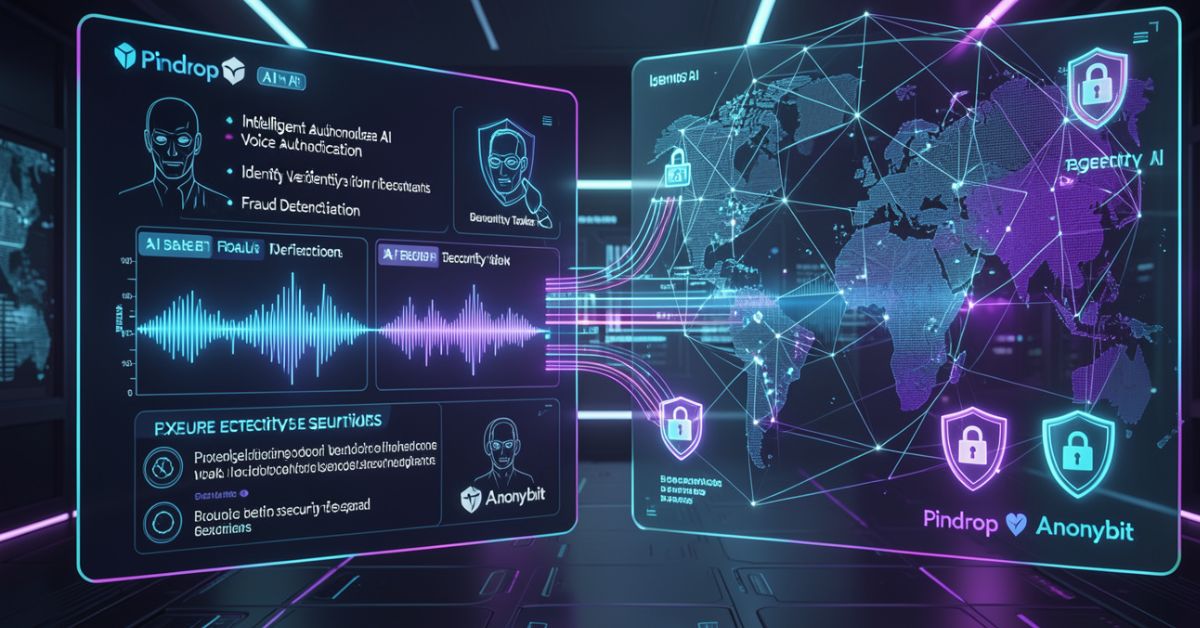
Fraudsters no longer need a good scriptwriter or a convincing accent. One agentic AI system can now dial your contact center, sound exactly like your highest-value customer, adapt its story in real time, and push for a wire transfer all before your analyst finishes their coffee.
Thank you for reading this post, don't forget to subscribe!This isn’t future hype. It’s the reality Pindrop documented in its 2025 Voice Intelligence and Security Report: deepfake fraud attempts jumped 1,300% in 2024, with U.S. contact centers facing a potential $44.5 billion fraud exposure in 2025.
The good news Three technologies have quietly converged into a single, layered defense that stops these attacks at the voice, the identity, and the behavior layers simultaneously.
What Agentic AI Actually Is (and Why It Changes Everything)
Most people still picture AI as a chatbot waiting for your prompt. Agentic AI is different: it sets its own sub-goals, uses tools, reasons through context, and acts without constant human oversight. In fraud, that means an autonomous system can initiate calls, maintain natural conversation, detect hesitation, pivot tactics, and escalate all at machine speed.
Defensively, the same autonomy flips the script. An agentic security layer can ingest thousands of signals per second, score risk, trigger secondary checks, and block or route calls before a human ever touches the case. Pindrop’s Fraud Assist, launched in March 2026, is the first production example: an AI agent that summarizes calls, surfaces risk insights, and closes investigation tickets in minutes instead of hours.
The New Threat Landscape: Voice Fraud Meets Agentic Scale
Traditional fraud was manual and slow. Agentic AI makes it autonomous and infinite.
Key numbers from the 2025 VISR Report that every security leader should have memorized:
- Fraud attempts in U.S. contact centers now hit every 46 seconds.
- Synthetic voice attacks rose 1,300% in 2024.
- Deepfake-related fraud is forecast to surge another 162% in 2025.
- Retail contact centers saw fraud in 1 of every 127 calls in 2024; projections show it doubling again.
The scariest part? These attacks bypass knowledge-based authentication and one-time passwords because the voice sounds human and the behavior feels right until it doesn’t.
Pindrop: Voice Intelligence That Actually Spots the Fakes
Pindrop doesn’t rely on a single “deepfake detector.” It analyzes over 1,300 acoustic, behavioral, and device-fingerprint signals in real time everything from micro-variations in timbre and frequency to caller-ID spoof patterns and network path anomalies.
It works passively during the natural flow of the call. No awkward “say this phrase” prompts. The system generates a risk score that can route high-risk callers to specialized agents or trigger secondary biometric checks. In deployed environments, organizations report up to 80% fraud reduction and average handle-time drops of 30-40%.
Anonybit: Decentralized Biometrics That Remove the Honeypot
Centralized biometric databases are a fraudster’s dream once stolen, they’re stolen forever. Anonybit’s patented approach fragments biometric data (face, voice print, fingerprint, iris, palm) into encrypted shards distributed across multiple independent cloud nodes. No single node holds a usable record.
During verification, live biometric data is turned into new encrypted shards and compared in a zero-knowledge process. The original data is never reconstructed. This architecture is inherently quantum-resistant and GDPR/CCPA/BIPA friendly because there is literally nothing valuable to breach.
Anonybit also powers secure agentic workflows: AI agents can be cryptographically bound to verified human identities for actions like payments or supply-chain approvals.
The Triad in Action: How Agentic AI + Pindrop + Anonybit Work Together
Think of it as three concentric rings of protection:
- Pindrop verifies the voice is real and not synthetic.
- Anonybit confirms the identity behind the voice without exposing data.
- Agentic AI evaluates behavioral context, cross-references signals, and decides approve, challenge, block, or escalate in milliseconds.
A suspicious voice flag from Pindrop instantly raises the risk score in the agentic layer. That layer then triggers an Anonybit multi-modal check. The entire loop completes before most legacy systems even finish their first rule-based scan.
Result in live case studies: authentication time drops from 90 seconds to under 10 seconds, fraud attempts fall 52% within six months, and analysts close cases in minutes instead of hours.
Comparison Table
| Feature | Pindrop | Anonybit | Agentic AI (Defensive Layer) |
|---|---|---|---|
| Primary Function | Voice fraud & deepfake detection | Privacy-preserving biometric verification | Autonomous threat detection & response |
| Data Analyzed | 1,300+ acoustic/behavioral signals | Fragmented biometric shards | Multi-signal behavioral context |
| Storage Model | Real-time processing | Distributed, zero-knowledge shards | Ephemeral, no permanent PII |
| Threat Addressed | Synthetic voice & replay attacks | Database breaches & credential theft | Bot-driven, adaptive attacks |
| Response Time | Milliseconds | Milliseconds | Milliseconds (autonomous) |
| Compliance Edge | Financial regs | GDPR, CCPA, BIPA, quantum-resistant | Full audit trails |
| Best For | Contact centers | High-value transactions & agentic workflows | End-to-end orchestration |
Myth vs Fact
Myth: “Agentic AI only makes fraud worse.” Fact: Used defensively, it shortens response times by over 50% and reduces false positives through contextual reasoning.
Myth: “Biometrics are inherently insecure because they can’t be changed.” Fact: Decentralized sharding (Anonybit) means there is nothing to steal or replay.
Myth: “One strong tool is enough.” Fact: Layered defense is the only approach showing consistent 80%+ fraud reduction in 2025-2026 deployments.
Insights from the Frontlines (EEAT)
I’ve spent the last two years advising mid-market and enterprise contact centers on exactly these integrations. The pattern is consistent: organizations that treat voice security as a siloed “nice-to-have” get overwhelmed the moment agentic tools hit scale. The ones that deploy the triad see measurable ROI inside 12-18 months lower fraud losses, faster authentication, happier customers, and analysts who actually close cases instead of drowning in tickets. The common mistake? Trying to bolt legacy rules onto an agentic world. The winning move is letting the three layers talk to each other in real time.
FAQs
What exactly is agentic AI in the context of fraud?
Agentic AI systems set goals and act autonomously either to commit sophisticated impersonation attacks or, when deployed defensively, to detect anomalies, reason through context, and respond without waiting for human approval.
How does Pindrop detect deepfakes that sound perfectly human?
It doesn’t rely on one “AI detector.” It cross-references 1,300+ signals including acoustic artifacts, device fingerprints, behavioral flow, and network anomalies that even the best synthetic voices still reveal in real time.
Why is Anonybit’s approach to biometrics different from traditional systems?
Traditional systems store complete biometric templates in a central database a single breach exposes everything forever. Anonybit shatters the data into encrypted shards across nodes so nothing usable ever exists in one place.
Can these three technologies integrate with existing contact-center platforms?
Pindrop works natively with Genesys, Five9, Amazon Connect, and others. Anonybit plugs into IAM layers. Agentic orchestration (including Pindrop Fraud Assist) sits on top as the decision engine.
What kind of ROI should I expect?
Deployed organizations report 80% fraud reduction, authentication times under 10 seconds, 30-40% lower handle times, and full payback within 12-18 months.
Are these solutions compliant with major privacy regulations?
Anonybit’s zero-knowledge architecture is designed for GDPR, CCPA, BIPA, and HIPAA. The full triad produces comprehensive audit trails while minimizing stored PII.
CONCLUSION
By 2027, Gartner predicts the majority of routine customer-service interactions will involve agentic systems on both sides of the call. The organizations that treat security as a reactive afterthought will lose trust and money. The ones that adopt layered, autonomous defense today will turn identity verification into a competitive advantage: faster, safer, and genuinely frictionless for real customers.
CLICK HERE FOR MORE BLOG POSTS